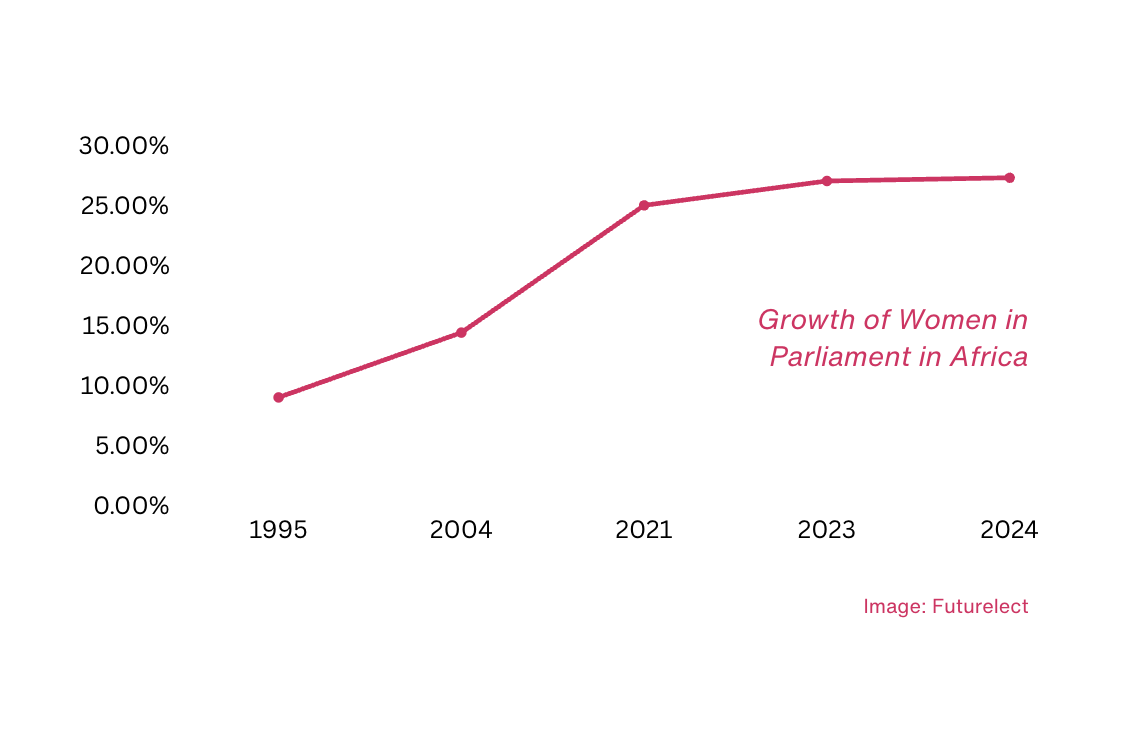
Despite political shifts across Africa, the representation of women and youth in national parliaments remains far too low. At the current pace, gender parity in African legislatures will not be achieved until 2100. This is unacceptable.
In 2024, women held just 23% of parliamentary seats in Kenya, a marginal increase over the past decade. Youth representation remains dismal due to systemic and financial barriers.
In South Africa, women occupy 44.5% of National Assembly seats, making South Africa one of the continent’s leaders in gender representation. However, young leaders still struggle to enter the political arena.
In July 2024, Ghana’s parliament passed the Affirmative Action Gender Bill to increase women’s representation to 30% by 2030. However, with women currently making up less than 15% of parliament, urgent action is needed to ensure this target is met.
Across Africa, progress is slow. Botswana’s 2024 elections brought a historic opposition victory but little change in women’s parliamentary representation. Namibia elected its first female president, Netumbo Nandi-Ndaitwah, yet women held parliamentary seats and did not see a corresponding increase. Angola continues to lag in both female and youth political participation.
The barriers are clear: socio-economic exclusion, cultural biases, and entrenched political structures favouring older established male figures. Without decisive interventions—such as gender quotas, financial support for young and women candidates, and civic education to activate public and youth participation—Africa will not see fair representation in its parliaments for another 75 years.
Futurelect is committed to breaking this cycle. Through political leadership development, resilience training, and civic education, we equip young people and women with the skills, networks, and resilience to lead. We are preparing a new generation of ethical political leaders and empowering an informed electorate to vote them into office and support them.
For more information contact Shaunei Gerber, Head of Marketing and Communications at Futurelect, shaunei@futurelect.org or visit www.futurelect.org. Download the Futurelect civics learning app on iOS, Google Play and Huawei.
About Futurelect
Futurelect, founded in 2018 in Johannesburg, is a non-profit organisation focused on transforming African political and government leadership. We empower young, ethical leaders with the skills to serve communities responsibly and with integrity. Our non-partisan programmes develop diverse, skilled political leaders, primarily targeting African women aged 18-45 pursuing or aspiring to leadership roles in politics and public office. We also offer a free online Civic Education Programme in South Africa, providing nonpartisan courses on democracy and governance for South Africans aged 16-34.
Data sources:
- https://www.idea.int/publications/catalogue/womens-political-participation-africa-barometer-2024?
- https://www.cnbcafrica.com/media/6358420392112/intl-idea-womens-representation-in-african-parliaments-rises-to-25-in-2024/?
- https://www.un.org/africarenewal/magazine/march-2024/women-parliament-slow-progress-towards-equal-representation?
- https://www.theguardian.com/global-development/2024/dec/31/fighting-for-change-why-road-to-parliament-is-still-rocky-for-women-in-africa?